
Every cell, whether it belongs to a human, a bacterium, or a blade of grass, has to turn food into energy and into the raw materials for building more of itself. The chemistry that solves this problem is surprisingly universal, and at its center sits one of the most famous loops in all of biology – the tricarboxylic acid cycle, better known as the TCA cycle, the citric acid cycle, or simply the Krebs cycle. The molecules involved in this process, known as central carbon metabolites, provide valuable insights into how cells produce energy and respond to changing conditions.
In biology books the cycle is usually pictured as a traffic roundabout. Fuel of almost any kind, such as sugar from a meal, fat from storage, or even protein when needed in a pinch, gets funneled toward a single small molecule called acetyl-CoA, which merges onto the roundabout. As it travels around the loop, it is taken apart step by step. Each turn strips off carbon (released as carbon dioxide, the gas exhaled with every breath) and harvests high-energy electrons that the cell later cashes in to make ATP, the molecular fuel that powers nearly everything a living thing does.
But the roundabout is not only a power plant. At every exit, other molecules can peel off to be used elsewhere, and new ones can merge on to keep traffic flowing. This dual identity of energy generator and parts depot is what makes the cycle’s intermediate molecules so informative. These central carbon metabolites are not just metabolic debris; their relative amounts form a readout of what a cell or a whole organism is doing at a given moment.
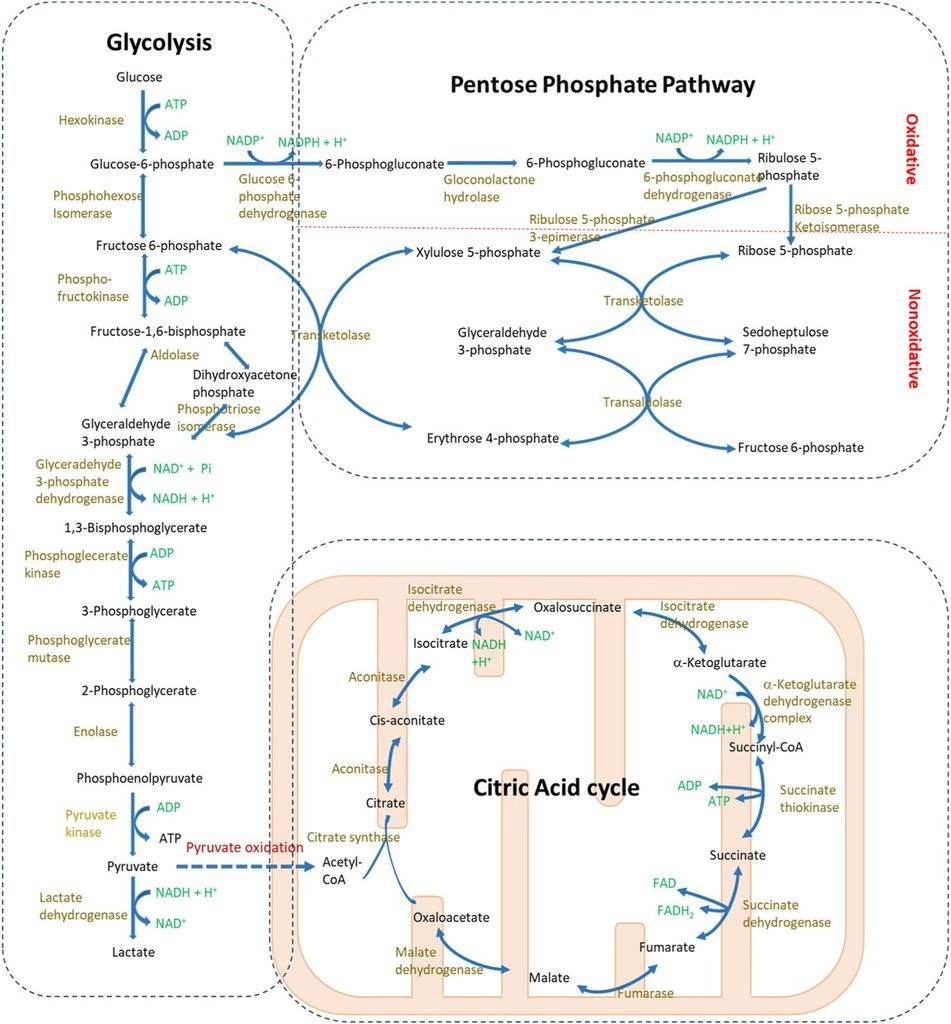
Key Central Carbon Metabolites and TCA Cycle Intermediates
A handful of these molecules, including key TCA cycle metabolites, deserve individual attention, because each one tells a particular story.
Lactate
Lactate is the molecule most people have felt. When muscles work intensely, the cell converts more pyruvate (the product of sugar breakdown that normally feeds the cycle) to lactate. A rise in lactate can therefore reflect increased glycolytic activity, although it does not necessarily indicate a lack of oxygen [1]. The same pattern appears in many tumors, which lean heavily on this shortcut even when oxygen is plentiful, a quirk that makes lactate a closely watched marker in cancer biology.
Citrate
Citrate is where the roundabout connects to fat. When a cell has energy to spare, citrate is shuttled out of the cycle and used as the starting block for building fatty acids and cholesterol. Its abundance hints at whether a cell is in a building mode or a burning mode.
Succinate and Fumarate
Succinate and fumarate have turned out to be quite important. Both accumulate during inflammation and low-oxygen stress, and both can act as signals that change how cells behave. When the enzymes that process them are disabled by genetic mutations, succinate and fumarate pile up and can drive certain cancers, earning them the nickname “oncometabolites” – ordinary metabolites that turn dangerous when they overflow [2].
Alpha-Ketoglutarate
Alpha-ketoglutarate sits at the crossroads between carbon metabolism and the machinery that switches genes on and off. It is a required molecule for a family of enzymes that edit chemical marks on DNA and proteins, which means its level can influence not just metabolism but which parts of the genome a cell is actively reading.
The lesson across all of these is the same: the pattern of central carbon metabolites is a snapshot of physiological state (fed or fasting, calm or inflamed, healthy or diseased).
Measuring Central Carbon Metabolites with Mass Spectrometry
Reading that snapshot reliably is the central analytical challenge. Central carbon metabolites are unforgiving analytes. They are low in molecular mass, highly polar, and ionic at physiological pH, properties that complicate both their retention on analytical columns and their ionization efficiency. Many are also structural isomers or isobars that share an identical elemental formula: citrate and isocitrate, for example, are indistinguishable by mass alone and resolvable only by separating them upstream of the detector. Gas chromatography-mass spectrometry is usually best for the smaller organic acids with high efficiency, but requires chemical derivatization to render them sufficiently volatile.
The most informative experiments move beyond inventory to kinetics. By supplying cells with a substrate enriched in a stable heavy isotope (typically carbon-13-labeled glucose or glutamine) and tracking the resulting mass shift as that labeled carbon propagates through successive intermediates, the technique can reveal not only the steady-state concentration of each metabolite but, when combined with appropriate modeling, the rates at which carbon traverses different branches of the network. This is the basis of metabolic flux analysis, and the distinction it captures, between the size of a metabolite pool and the velocity of the reactions feeding it, is frequently where the biologically important signal resides [3].
The TCA Cycle in Human Cells and Microbes
Although the roundabout is ancient and shared, the way different organisms drive around it varies in ways that matter, especially when human cells and microbes are compared.
Mammalian cells generally run the full loop in the forward direction to extract maximum energy. Microbes are far more improvisational. Many bacteria, particularly those living without oxygen in environments like the gut, run only part of the cycle, leaving it open-ended rather than closed. Some can even run portions of it in reverse to pull carbon dioxide out of the air and build molecules from scratch. A number of microbes, plants, and fungi also possess a shortcut absent in humans, called the glyoxylate bypass, that lets them grow on simple two-carbon foods such as the acetate produced by fermentation.
These differences are not just a curiosity, because the human gut microbiome plugs directly into host metabolism through exactly these molecules. The short-chain fatty acids that gut bacteria make from dietary fiber, such as propionate, can be converted by human tissues into succinyl-CoA and fed into the host’s own cycle [4]. The chemistry of one organism becomes the fuel of another, and measuring the shared intermediates is one of the few ways to see that exchange happening.
How Carbohydrates, Fats, and Proteins Feed the TCA Cycle
It is worth stepping back to see how the whole pantry connects. Carbohydrates are broken down to pyruvate and enter near the top of the loop. Fats are dismantled into acetyl-CoA and merge on at the same point, which is why the roundabout is the common destination for both a sugary and a fatty meal. Proteins, once disassembled into amino acids, join at several different exits and entrances depending on which amino acid is involved. The cycle is the place where these separate supply lines meet, mix, and get accounted for, which is precisely why its intermediates carry so much information about the state of the system as a whole.
Central Carbon Metabolomics at Arome Science
Reading that information at scale, across many samples and many people, is where modern metabolomics is headed.
The intermediates of central carbon metabolism are among the most universal and most interpretable molecules in biology, and making their measurement routine and accessible is part of what Arome Science works to enable. To that end, Arome Science offers targeted panels that cover the full set of important central carbon metabolites – lactate, the TCA cycle intermediates, and the related acids and cofactors, turning a precise chemical snapshot into a practical window onto health, disease, and the unseen partnership between a body and its microbes.
Frequently Asked Questions About Central Carbon Metabolites
What are central carbon metabolites?
Central carbon metabolites are small molecules involved in the biochemical pathways that process nutrients, generate energy, and provide building blocks for cellular functions. Examples include lactate, citrate, succinate, fumarate, and alpha-ketoglutarate.
Are central carbon metabolites the same as TCA cycle intermediates?
Not exactly. TCA cycle intermediates are part of central carbon metabolism, but the broader network also includes glycolysis and other connected pathways. Lactate, for example, is a central carbon metabolite but is not a direct intermediate of the TCA cycle.
How are central carbon metabolites measured?
Central carbon metabolites can be measured using mass spectrometry combined with liquid or gas chromatography. Targeted metabolomics methods allow researchers to identify and quantify selected metabolites in biological samples.
Can metabolite concentrations reveal metabolic flux?
Metabolite concentrations provide a snapshot of the metabolic state, but they do not directly reveal the rates of metabolic reactions. Stable isotope tracing, combined with appropriate analysis and modeling, can provide additional information about metabolic flux.
