
The word biomarker gets used loosely, often to describe any molecule that seems to track with a disease. Yet the path that separates an interesting observation in a research dataset from a measurement a physician can act on is long, winding, and populated with far more failures than successes. The distance between biomarker discovery and validation is worth understanding, because it explains why so few of the molecules celebrated in scientific papers ever reach a clinical laboratory.
How Biomarker Discovery Works in Metabolomics
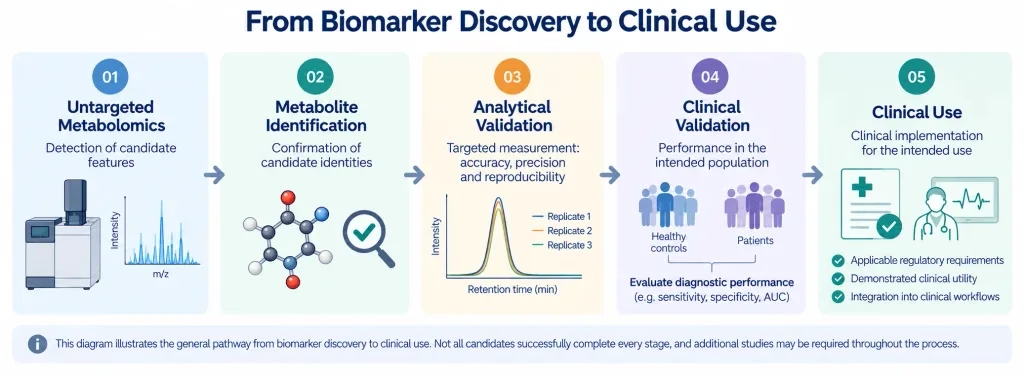
Discovery typically begins in the realm of untargeted metabolomics , an approach in which a broad range of small molecules present in a biological sample, whether blood, urine, stool, or exhaled breath, is measured without deciding in advance what to look for, so that instead of asking whether a particular compound is present, the instrument records everything it can detect and leaves the interpretation for later. When samples from a group of people with a condition are compared against samples from people without it, statistical analysis surfaces the molecules whose abundances differ most consistently between the two groups. Those molecules then become candidates worth exploring further, in order to understand whether the difference reflects the disease itself, a downstream consequence of the disease, or something incidental such as a dietary habit shared among the patients or a medication they all take.
Some of the most familiar examples of this logic predate modern instrumentation but illustrate the principle cleanly. Phenylketonuria, an inherited disorder in which the body cannot break down the amino acid phenylalanine, produces a dramatic buildup of that single compound in the blood of affected newborns, and the detection of that elevation forms the basis of a screening test administered to nearly every baby born in the developed world. Diabetes , similarly, is monitored through the concentration of glucose, a single small molecule whose relationship to the disease is direct enough that decades of clinical practice have been built around measuring it.
Why a Single Metabolite Is Rarely Enough
These clean cases, however, are the exception rather than the rule, because biology rarely arranges itself so that one molecule maps neatly onto one condition. Most diseases involve interconnected shifts across many metabolic pathways at once, so that no single compound rises or falls with enough consistency and specificity to serve as a standalone indicator, and the meaningful signal appears instead in the pattern, in the way dozens of molecules move together in a particular fashion that reflects the underlying physiology. Cardiovascular risk, for instance, has been linked not to any one metabolite but to combinations that include trimethylamine N-oxide (a compound generated when gut bacteria process certain nutrients found in red meat and eggs) alongside particular amino acids, and insulin resistance tends to reveal itself as an altered balance among branched-chain and aromatic amino acids rather than as the elevation of any single one of them.
Cancer Breath Biomarkers: Promise and Challenges
Cancer offers perhaps the most extreme illustration of both the promise and the frustration of this pattern-based reality. Researchers have repeatedly reported that the breath of people with certain cancers contains altered levels of volatile organic compounds, among them long chain alcohols, aldehydes, and hydrocarbons that arise from processes such as the oxidation of the lipids that make up cell membranes, and the appeal of a test able to detect cancer from a simple exhalation is obvious. Yet despite decades of encouraging studies, breath-based cancer detection has not become an established part of routine clinical screening, in part because the signal is diffuse, variable from one individual to the next, and difficult to disentangle from the countless other influences on the composition of exhaled air, ranging from diet to the bacteria living in the mouth. [1]
Metabolite Identification: From Unknown Features to Known Molecules
A further obstacle, easy to overlook, is that a molecule cannot function as a biomarker while it remains unidentified. Untargeted metabolomics routinely detects many thousands of features, meaning distinct analytical signals that do not necessarily correspond one-to-one with individual molecules, but a large fraction of those signals cannot immediately be matched to a known chemical structure, and a mysterious peak that reliably separates the sick from the healthy is scientifically tantalizing while remaining clinically useless until its structure has been deciphered, a process that can demand considerable analytical effort involving additional experiments and careful comparison against reference standards. Only once the identity of the molecule is settled, does it become possible to manufacture a standard, calibrate an assay against it, and eventually measure it in a way another laboratory could reproduce. [2]
Why Biological Interpretation Matters in Biomarker Discovery
Even after a candidate molecule has been identified and its association with a condition established, the work is far from finished, because a correlation on its own carries little weight without an understanding of why the molecule behaves as it does.
The biological mechanism connecting the molecule to the disease can help explain why the elevation or depletion makes physiological sense rather than appearing as an unexplained statistical coincidence that might just as easily vanish in the next cohort, and when identity, association, and mechanism all align, the evidence supporting a candidate biomarker becomes substantially stronger.
Biomarker Validation: Reproducibility and Clinical Performance
That designation, however, marks the beginning of validation rather than its conclusion, and validation is its own multi-faceted undertaking that turns out to be where most candidates quietly disappear. A carefully designed clinical study first has to establish how much the molecule varies among healthy people to begin with, since a marker that swings widely from one person to the next, or within the same person across a single day or across the seasons, offers very little diagnostic footing, and that natural variability then has to be weighed against the difference the disease actually produces in order to judge whether the two states can be told apart at all. [3]
The study must also characterize the diagnostic power of the marker in concrete terms, asking how often it correctly flags the people who have the condition and how often it wrongly flags the people who do not, because a test that catches every case while also alarming half the healthy population is nearly as unhelpful as one that misses cases outright. The balance struck between those two kinds of error is what ultimately determines whether a result can be trusted to guide a decision.
Layered on top of these questions are the confounders that complicate every real population, since diet, medication, age, sex, body weight, and coexisting conditions each leave their own imprint on the metabolome, and a validated biomarker has to hold up across the messy diversity of actual patients rather than only within the tidy confines of an initial study group. [4]
This is why the whole exercise usually has to be repeated in progressively larger and more varied cohorts before anyone can be confident the original finding was real and not an artifact of one particular set of samples.[5]
Pre-analytical variability can also affect the reliability of biomarker measurements, making sample preparation in metabolomics an important consideration. Analytical reliability also depends on appropriate quality control and method validation .
From Metabolomics Research to Clinical Practice
Stepping back from the individual hurdles reveals a broader truth about the current state of the field, which is that many small-molecule biomarker candidates reported in metabolomics research remain far less represented in routine clinical practice than one might expect.
Many established disease-specific biomarkers are proteins, the larger molecules such as prostate-specific antigen or cardiac troponin whose measurement is well established and deeply embedded in clinical workflows. Although small molecules such as glucose and creatinine are also routinely measured, many of the newer metabolomic biomarkers reported in research have yet to make the transition into clinical practice.
Part of the path forward may involve a conceptual shift away from the search for the perfect single compound and toward wholesale profiling of the metabolome, in which diagnostic value is read from the coordinated pattern across many molecules at once rather than from any one of them in isolation, an approach that fits the pattern-based biology described earlier far more naturally.
Applying metabolome-wide profiles as routine clinical tests, however, remains technically demanding and very much a work in progress.
Biomarker Discovery and Validation at Arome Science
Arome Science works on both sides of this process, applying untargeted metabolomics for the discovery phase, where the goal is to survey a broad molecular landscape and surface the candidates worth pursuing, and targeted metabolomics for the analytical validation phase, where specific molecules are measured with the precision and reproducibility needed for reliable quantitative analysis.
These together span the arc from the first faint hint of a difference between two groups toward the rigorous evaluation needed to establish what a measurement can reliably mean.
Frequently Asked Questions About Biomarker Discovery and Validation
What is the difference between biomarker discovery and validation?
Biomarker discovery identifies measurable characteristics associated with a biological condition. Validation evaluates whether a candidate can be measured reliably and whether its performance supports a specific intended use.
Why do many discovered biomarkers fail clinical validation?
Promising candidates may fail because of biological variability, analytical limitations, confounding factors, or poor reproducibility across independent patient populations.
How are untargeted and targeted metabolomics used in biomarker research?
Untargeted metabolomics enables broad profiling to identify candidate metabolites, while targeted metabolomics supports their precise measurement and analytical validation.
Can a biomarker be clinically useful without a fully understood biological mechanism?
Yes. A complete mechanistic explanation is not always required, provided that sufficient evidence supports the biomarker’s reliability and its intended clinical use.
