
In untargeted metabolomics, one of the greatest challenges is identifying the molecules detected by mass spectrometry. Most acquired tandem mass spectra (MS/MS) do not match compounds in existing reference libraries, leaving much of the metabolome unexplored.
A suspect spectral library offers a way to extract meaningful chemical information from these unknown spectra. By using molecular networking to connect molecules with similar fragmentation patterns, researchers can propose structural relationships and extend annotations beyond compounds already represented in reference libraries.
A study published in Nature Communications in 2023 demonstrated how this approach can be applied across public metabolomics repositories to create a reusable nearest neighbor suspect spectral library containing 87,916 experimental MS/MS spectra.
Why Most Metabolomics Spectra Remain Unidentified
In untargeted metabolomics, molecules are identified by matching their tandem mass spectra (MS/MS) against reference libraries built from spectra of known compounds, usually acquired with standards.
Only about 5% of spectra in a typical dataset can be annotated this way (roughly 10% for human samples), and the unannotated remainder is commonly referred to as the dark matter of the metabolome.
However, many unannotated molecules are structural analogs of library compounds with relatively small structural differences, such as:
- Hydroxylation
- Methylation
- A double bond
- A sugar substitution
How Molecular Networking Supports Suspect Spectral Library Development
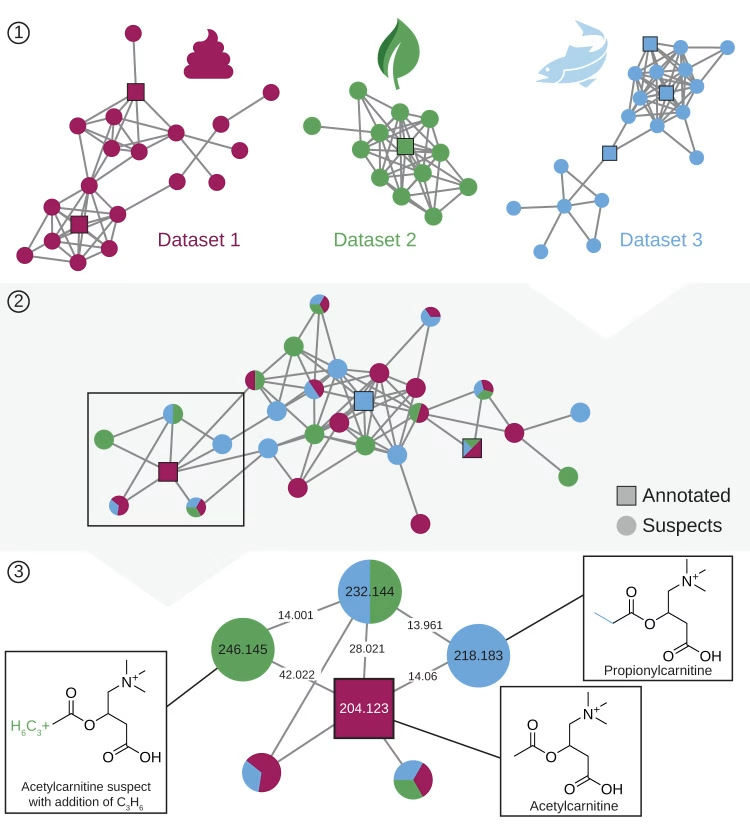
Molecular networking connects spectra with similar fragmentation patterns, so that structurally related molecules group into molecular families.
Because a library match for one member of a family constrains the possible identities of its neighbors, annotations can be proposed by association: an unknown connected to cholic acid with a mass difference of +15.995 Da is most likely a hydroxylated cholic acid.
Such propagation has been routinely performed by manual inspection of individual clusters, and the resulting annotations have typically remained confined to the study in which they were made.
Building a Repository-Scale Suspect Spectral Library
In a recent work, propagated annotations were collected at repository scale and compiled into a reusable spectral library.
A total of 521 million MS/MS spectra from 1,335 public datasets deposited in GNPS/MassIVE, MetaboLights and Metabolomics Workbench were combined into a single global molecular network.
These datasets covered diverse biological and environmental samples, including:
- Microbial cultures
- Food
- Soil and seawater
- Marine invertebrates
- Human samples
Figure 1. Creation of the nearest neighbor suspect spectral library.
Source: Bittremieux et al., Nature Communications 14, 8488 (2023). https://doi.org/10.1038/s41467-023-44035-y. Licensed under CC BY 4.0: https://creativecommons.org/licenses/by/4.0/
For a broader overview of how spectral databases support metabolite identification, see our guide to metabolomics data analysis.
How Suspect Spectral Library Entries Were Generated
Unannotated spectra connected to library-matched spectra with high spectral similarity and a recurrent mass offset were retained as “suspects.”
Each suspect was labeled with:
- The name of the matched neighbor
- The mass difference
- A predicted molecular formula
- Where available, a putative chemical explanation of the mass difference
The resulting nearest neighbor suspect spectral library comprises 87,916 spectra and is freely available through the GNPS Suspect Library.
In contrast to most entries of conventional libraries, which are acquired from standards and are rarely observed in public data, every suspect spectrum originates from an actual biological or environmental sample.
How the Suspect Spectral Library Improves MS/MS Annotation Rates
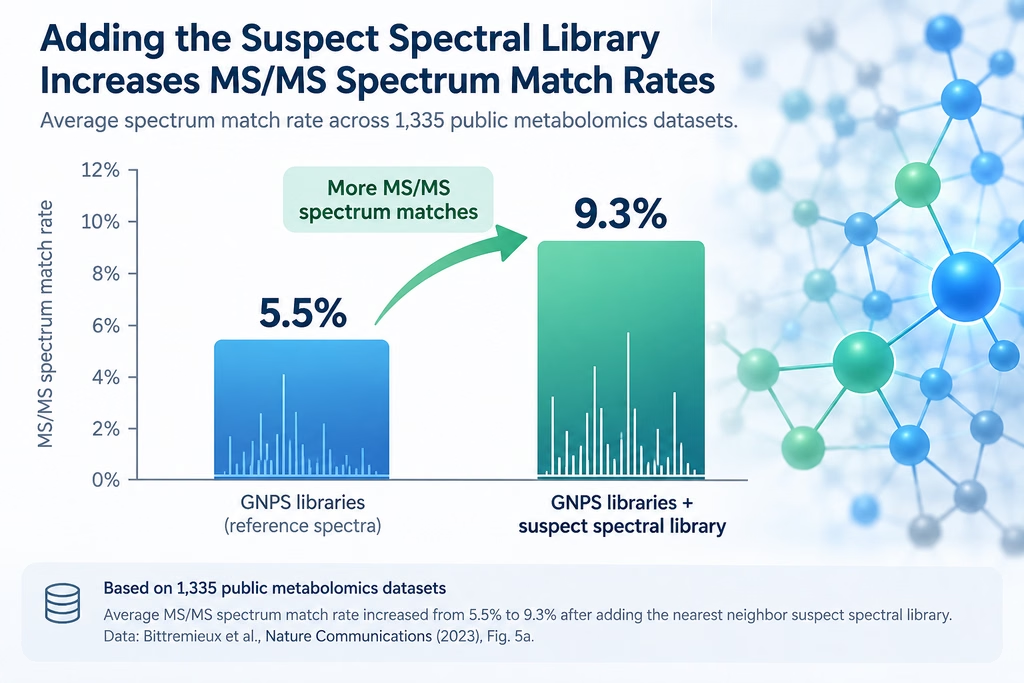
Searching public data against the GNPS libraries supplemented with the suspects increased the average annotation rate from 5.5% to 9.3%, with comparable gains for 72 datasets deposited after the library was created.
The increase ranged from 1.7-fold for food to approximately three-fold for environmental samples.
Acylcarnitine Annotations in Alzheimer’s Disease Research
In a cohort of 514 human brains from individuals with and without Alzheimer’s disease, the number of unique annotations increased from 1,305 to 5,184.
Annotations of acylcarnitines, the carriers of fatty acids into mitochondria, increased from 12 to 104, with four of the acylcarnitines associated with Alzheimer’s diagnosis recognized as such only through suspect matches.
Revealing Molecular Families Through Network Propagation
With the suspects included, a larger fraction of nodes in each molecular family carries an annotation, and an unknown spectrum is consequently more often surrounded by several annotated neighbors.
Individual suspect annotations are approximate, as the site of modification generally cannot be determined from the spectrum, and correspond to family-level (MSI level 3) annotations.
When the annotations within a cluster are consistent and point to the same compound class, they collectively point to the chemistry of the cluster with reasonable confidence.
The HOMEChem Dataset: Identifying Hidden Chemical Diversity
In the HOMEChem dataset, in which surfaces of a house were sampled before and after a month of occupancy, standard libraries yielded a single match to an octylphenol polyethylene glycol ether, whereas the suspect library added 55 related matches and revealed an extensive family of these compounds that would otherwise have been represented by one annotation.
This would have given a false impression that these compounds are uncommon, rather than the reality that these are some of the most often observed compounds in a human environment.
Why Suspect Spectral Library Annotations Require Validation
The suspects are hypotheses, and definitive structures still require authentic standards or NMR confirmation.
Where such confirmation was performed, the proposed structures were supported:
- Two acylcarnitine suspects matched purchased standards.
- NMR of a semi-purified fraction was consistent with the structure proposed for a new apratoxin analog from the cyanobacterium Moorena bouillonii.
For most practical purposes, assigning an unknown discriminant feature to a molecular family, such as a hydroxylated acylcarnitine, a pentose-substituted flavonoid glycoside or a demethylated drug metabolite, provides a starting point for a more detailed follow-up and is considerably more informative than an unannotated m/z value.
For more on the importance of confirming preliminary molecular findings, see The Distance Between Biomarker Discovery and Validation.
Applications of Suspect Spectral Libraries at Arome Science
The same considerations apply outside of academic research.
At Arome Science, untargeted metabolomics is applied to practical questions in which the features that differentiate sample groups are, as in most studies, largely absent from reference libraries.
Family-level annotations obtained through network propagation are often what enables us to begin interpretation of the results and prioritization of candidates for confirmation with standards.
Open, community-built resources such as this suspect spectral library make such applications considerably more tractable.
Frequently Asked Questions
What is a suspect spectral library?
A suspect spectral library is a collection of experimental mass spectra associated with proposed molecular annotations. These annotations can be derived from relationships between unknown spectra and known reference compounds, helping researchers investigate molecules that are not represented in conventional spectral libraries.
How does molecular networking help build a suspect spectral library?
Molecular networking groups MS/MS spectra according to similarities in their fragmentation patterns. When a spectrum matches a known reference compound, the relationships between neighboring spectra can be used to propose annotations for structurally related molecules.
Can suspect spectral library matches confirm metabolite identities?
No. Suspect spectral library matches provide preliminary structural hypotheses, often at the molecular-family or compound-class level. Definitive structural identification generally requires additional experimental evidence, such as authentic reference standards or NMR analysis.
